Our model

Theory of change

Three parts and fifteen steps: the need, the work we do, and the results we aim for.

Three parts, fifteen steps

Our theory of change on one screen

How to read this: the need on the left, the work in the middle, the results on the right. Select a step to read it. Targets and plans are labelled.

Part 1

The need

Why this work matters, who it is for and why we do it.

1

Problem

Learners can recall but not yet use what they know, and their challenges rarely enter the classroom. Projects lack a method, tool use lacks a framework, and assessment rewards recall.

Aligned with Sustainable Development Goal 4, Quality Education (opens in a new tab) (target 4.4, youth skills) and Sustainable Development Goal 5, Gender Equality (opens in a new tab). See the Problem and the Evidence
2

People

Secondary learners, S1 to S4, in Kyangwali Refugee Settlement and its host communities. Girls are affected most: 44% of S1 learners at Spectrum Secondary School but 13% of S4 (Spectrum records, Term One 2026).

  • 156,248 residents of Kyangwali (UNHCR and OPM proGres population dashboard, 28 February 2026).
  • 31,625 young people aged 15 to 24 (UNHCR and OPM, 30 September 2026).

Boundaries: secondary education only, starting at Spectrum Secondary School.

3

Reason

"Talent is everywhere. Opportunity should be, too."

SXLA's Founder went to school in Kyangwali. School gave him knowledge, but not the skills, tools and mindset to use it. Learners here are not short of ability, only of exposure. Read the Founder's Story

Part 2

The work

What we put in, what we do, who we work with and what must change.

4

Inputs

  • Protected time for JEP inside the school timetable.
  • A properly equipped Studio: the Hybrid Edge JEP Studio at Spectrum Secondary School (see specification).
  • Teachers who are trained and coached.
  • The JEP curriculum, facilitator guides and assessment.
  • Mentors, and safeguarding for every learner.
  • Funding through SXLA and Spectrum TechLabs Alliance (STA), our US-based partner.
5

Interventions

  1. The JEP learning cycle in curriculum time: DISCERN, PROMPT, PROTOTYPE, FEEDBACK.
  2. Teacher development: training and regular coaching.
  3. The offline-first Hybrid Edge JEP Studio.
  4. Mentoring for learners.
  5. Reaching partner schools through the Hub-and-Box Model, after the 2027 review at Spectrum.
6

Partners

Schools and education authorities; technology and connectivity partners; funders, with STA in the United States; mentors and experts; parents and the community.

What we say no to: replacing the national curriculum or teachers; primary education; general relief; technology without teaching.

7

Behaviours

  • Learners notice, question, check sources, act and improve.
  • Teachers teach what is needed at the moment learners need it, and coach.
  • Schools protect time for projects.
  • Parents and the community bring real problems and support learners.
8

Big idea

"Create the conditions that make a learner want to know. Then teach them how to find out."

9

Mission

SXLA's mission: To inspire and equip youth to achieve breakthroughs that accelerate an abundant future for all through technology.

In one line: SXLA helps secondary learners in refugee and rural communities turn real problems into knowledge, action and value, through the 360° JEP Studio inside Uganda's curriculum.

Part 3

The results

Where the work leads, from what we deliver to our vision.

10

Pathways

  1. Scale through partner schools: the Hub-and-Box Model and its JEP Mobile Kit, after the 2027 review.
  2. Sustainability through local ownership and a second school sustained largely by local fees: MTP Secondary School (planned).
11

Outputs

Target For the 12-month project year that follows the 2027 review at Spectrum. These are targets, not results.

  • 12 teachers trained in JEP.
  • Hybrid Edge Studio built, powered, connected and equipped by month 5.
  • Learners per computer in the core cohort from 4 to 1.
  • 100% of sessions run fully, including during Internet outages.
  • 20 quests completed through all four stages.
  • 40 core learners with an up-to-date digital portfolio.
  • 2 assessment rounds with JEP and comparison learners, 80 learners each.
  • 120 learners in peer-led clubs, half of them girls.
  • Safeguarding policy and lead in place by month 2; 100% of mentors vetted.
12

Short-term outcome

Target 6 to 12 months.

Learners in the core cohort move up SXLA's five-level capability scale. The share of JEP learners at Level 4 (Capable) or above rises from 30% to 50%, measured against a comparison group.

13

Long-term outcomes

Target 12 to 24 months and beyond.

  • Learner agency and applied capability: learners transfer what they can do to unfamiliar problems (score from 2.0 to 2.5), and girls stay in the core cohort (retention from 85% to 95%).
  • Teaching practice: sessions meeting the practice standard rise from 40% to 75%, and JEP becomes standard practice beyond the core cohort within two to three years.
  • Model readiness: the model is documented, measured and shared with district and national bodies (3 briefings).
14

Ten-year target

Planning scenario, not a commitment

By 2036: about 1,080 learners across Spectrum and MTP Secondary, around 16 mobile studios serving about 64 partner schools, and about 2,640 JEP Scholars a year. Our ten-year plan

15

Vision

SXLA's vision: A world where every young person has the skills, tools and opportunities to shape a stable, abundant and thriving future.

Spectrum Secondary School's vision: a generation that understands reality, discovers what is possible, and acts to leave the world better than they found it.

Development hypothesis. If learners repeatedly meet real situations in protected curriculum time, in a properly equipped learning space; and teachers teach the knowledge each situation requires at the moment learners need it; and responsibility moves from teacher to learner as capability grows; then learners develop the agency and applied capability to move from reality to knowledge to action and back to learning. Because that capability does not depend on one subject or career, it serves them in further education, work, enterprise and community life.

The learning engine

How change happens inside each learner

Each turn leaves the learner with a sharper question and more decisions in their own hands. A loop, not a fixed sequence, shown through Baraka, an illustrative learner.

The JEP learning engine, following BarakaEleven steps arranged in a circle around the learner: Notice, Realize, Mindset, Purpose, Question, Knowledge Gap, Search, Choose Tools, Act, Feedback, Improve. After Improve, the engine turns again with new questions. Baraka is an illustrative learner, not a real person.The learnerBaraka (illustrative)1 NOTICE2 REALIZE3 MINDSET4 PURPOSE5 QUESTION6 KNOWLEDGEGAP7 SEARCH8 CHOOSETOOLS9 ACT10 FEEDBACK11 IMPROVE
The learning engine, following Baraka. Baraka is an illustrative learner, not a real person.
  1. 1 NOTICEBaraka notices that his family's plot grows too little food.
  2. 2 REALIZEHe realises it matters: there is not enough to eat, and the plot cannot get bigger.
  3. 3 MINDSETHe believes he can find out more, instead of accepting things as they are.
  4. 4 PURPOSEHe decides to help his family grow more food in a small space.
  5. 5 QUESTIONHe asks why the plot gives so little, and how a small space could grow more.
  6. 6 KNOWLEDGE GAPHe works out what he does not yet know: what plants need, and how to use space well.
  7. 7 SEARCHHe learns from his teacher, books, local farmers and online sources he checks.
  8. 8 CHOOSE TOOLSHe chooses containers, seeds, a notebook and, with his teacher, an AI assistant he checks.
  9. 9 ACTHe builds a vertical container garden with classmates.
  10. 10 FEEDBACKHe measures growth and asks his teacher, classmates and a farmer for advice.
  11. 11 IMPROVEHe changes the soil and watering, records what changed, and new questions begin.
Learner outcomes

Eight capabilities

Expected levels on SXLA's five-level scale (1 Beginning, 2 Emerging, 3 Developing, 4 Capable, 5 Advanced): 2 by the end of Explorer, 3 by the end of Investigator, 4 by the end of Innovator.

  • NoticeObserve accurately, separate fact from opinion, state a specific problem
  • QuestionAsk investigable questions and pursue them
  • Find outName gaps; find, judge and verify knowledge, including from AI
  • ChooseSelect tools and methods for the task, and say when not to use them
  • ActBuild a testable response and run a fair test
  • LearnDraw conclusions the evidence supports, including from failure
  • ImproveMake evidence-based improvements
  • ExplainExplain decisions, evidence and limits; transfer learning
Targets

Key outcome indicators

Baselines and 12-month targets from SXLA's JEP results framework, for the project year that follows the 2027 review at Spectrum. These are targets, not results.

LevelIndicatorBaselineTarget
GoalShare of JEP learners at Level 4 or above30%50%
PurposeMean capability score of JEP learners3.33.7
PurposeDifference between JEP learners and comparison group1.5 levels1.8 levels
IR 1Initiative and decision-making score4.04.3
IR 1Transfer to an unfamiliar problem2.02.5
IR 1Quests completed through all four stagesNot recorded20
IR 1Quests tested with real users20%75%
IR 1Girls in the core cohort41%50%
IR 1Girls retained in the core cohort85%95%
IR 2Sessions meeting the practice standard40%75%
IR 3Assessment rounds with JEP and comparison learners02 rounds, 80 learners each
IR 3Core learners with an up-to-date digital portfolio040
IR 3District and national briefings03

All learner results will be reported by sex, class and displacement status. Participation is never reported as an outcome.

What must hold true

Assumptions and risks

  • Teachers can guide inquiry while still teaching directly

    If it does not hold: Quests become lectures or unguided activity. How it is managed: Training, monthly coaching, facilitator guides, session observation.

  • Learners have, or are supported to reach, enough literacy and numeracy

    If it does not hold: Weaker learners fall behind; team products hide gaps. How it is managed: Entry checks; bridge support; individual explanations.

  • The local server and power are maintained

    If it does not hold: Technology-based work stalls. How it is managed: Hybrid Edge design: core learning runs locally when the Internet fails; UPS and solar for core equipment; every activity has a paper route.

  • Real feedback is available from users and mentors

    If it does not hold: Feedback becomes opinion, not evidence. How it is managed: Mentor network; community users; peer challenge.

  • Adults hand decisions to learners over time

    If it does not hold: Learners stay dependent. How it is managed: Progression framework; Innovator quests learners design themselves.

  • Learners, especially girls, stay in school

    If it does not hold: Benefits are lost. How it is managed: Half of core places for girls; female mentors; retention tracking.

  • The comparison group is comparable

    If it does not hold: Gains are overstated or understated. How it is managed: Matching by class and sex; blind scoring; context recorded.

What JEP claims, and what it does not. SXLA is directly accountable for delivering inputs, activities and outputs. Learner capability and longer-term outcomes also depend on learners, families, teachers and context, so JEP claims a contribution to them, supported by evidence from a comparison group, not sole cause. JEP does not claim that every learner will follow the same path, that every problem can be solved, or that success means starting businesses.

Official reference model

The full model

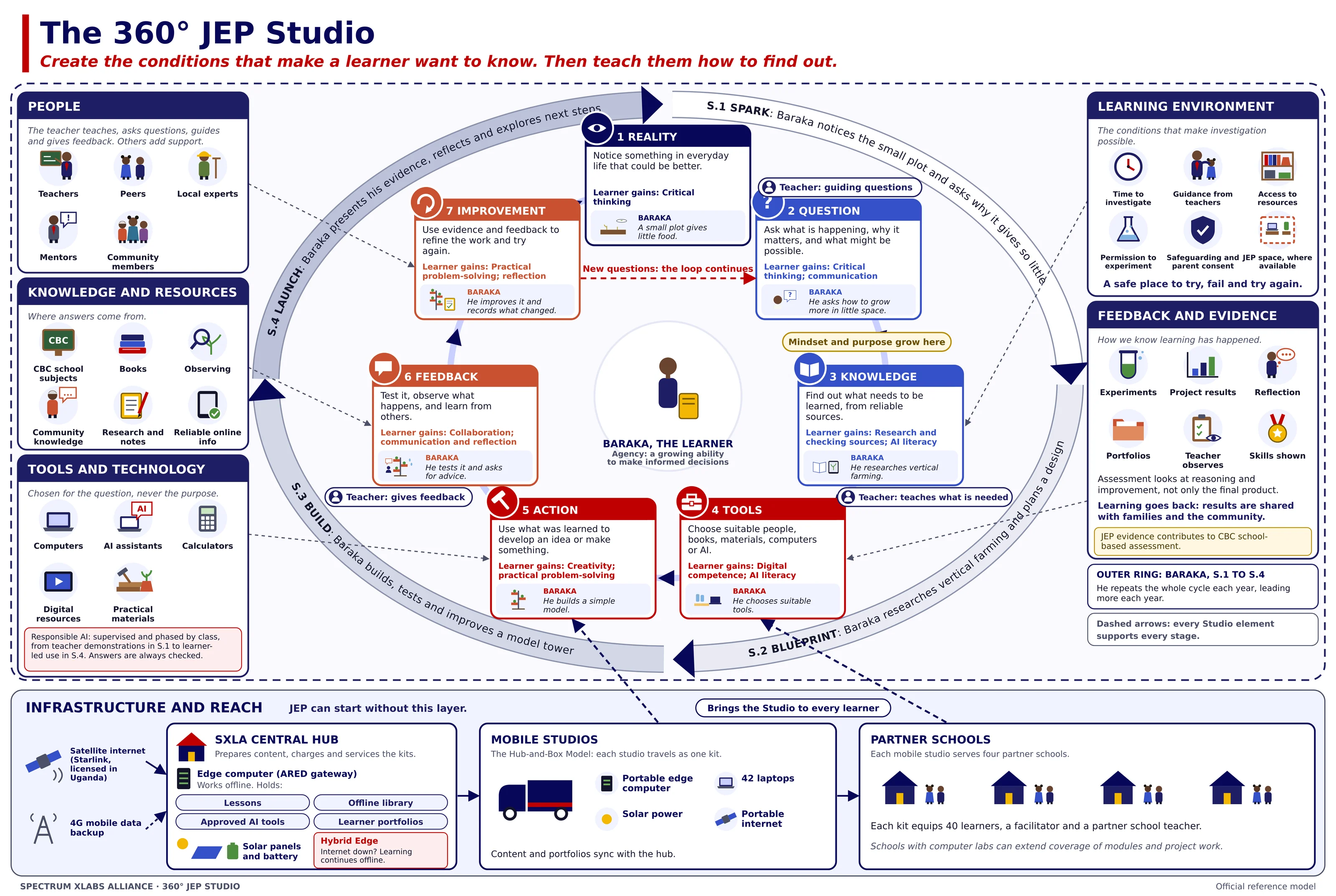
The official 360° JEP Studio model. A learner at the centre moves through seven steps (reality, question, knowledge, tools, action, feedback, improvement), supported by people, knowledge and resources, tools and technology, the learning environment, and feedback and evidence, with infrastructure and reach shown below.Select to enlarge
The official 360° JEP Studio model.
Keep exploring

Explore more

Long-term goal

A generation that understands reality, discovers what is possible and acts.

Find out more